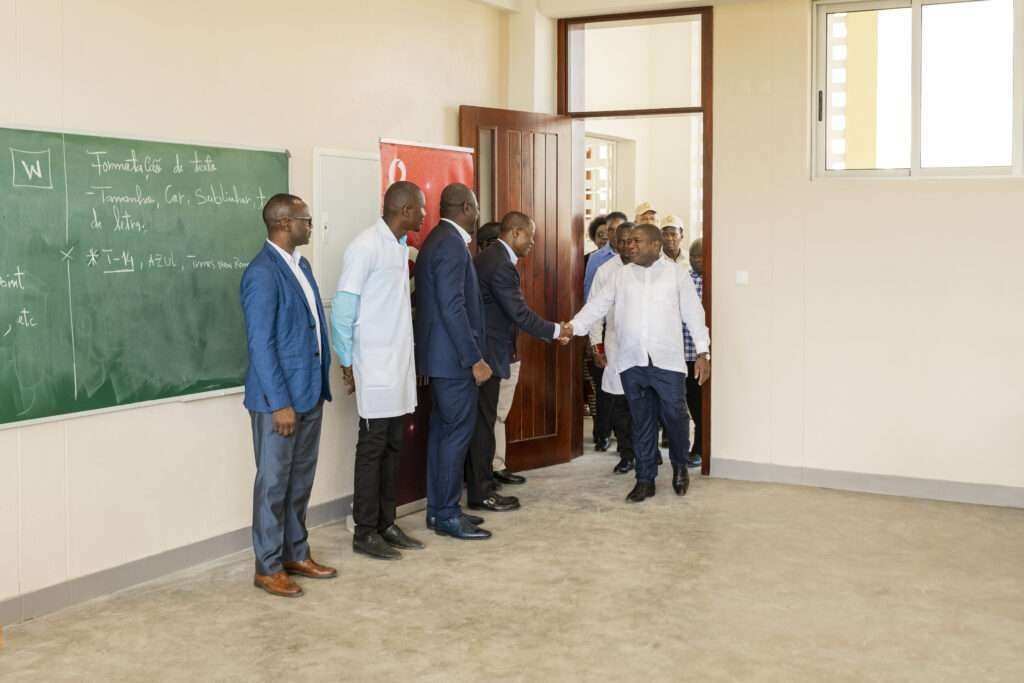
A Vodacom Moçambique, sob a égide do seu programa visionário “Faz Crescer”, anuncia, durante a cerimónia de abertura do ano lectivo de 2024, a inauguração de dois laboratórios de informática, na Escola Secundária de Mafambisse, Dondo, Sofala.
Este evento, não só simboliza o compromisso da Vodacom com a educação e tecnologia, mas também marca um avanço no desenvolvimento digital em Moçambique. Estes laboratórios, equipados com um total de 50 computadores avançados e uma robusta oferta de 600 Gigabytes de Internet gratuita mensal, estão destinados a se tornar um centro de excelência em aprendizagem.
Este investimento representa um novo horizonte de oportunidades para os estudantes de Mafambisse, abrindo portas para um mundo de conhecimento digital e habilidades do século XXI. “Através do Faz Crescer, já conectamos mais de 120 escolas com internet gratuita, e já oferecemos 85 laboratórios de informática. Hoje, celebramos mais um passo nessa jornada, reforçando o nosso compromisso em conectar as gerações futuras às oportunidades ilimitadas que a tecnologia oferece. A inauguração de dois novos laboratórios de informática na Escola Secundária de Mafambisse, a maior escola secundária do país, é um reflexo do compromisso da Vodacom com o futuro da nossa nação. Acreditamos firmemente que, ao investir em infra-estruturas educacionais como esta, estamos a investir no futuro do país.”, destacou Lucas Chachine – Presidente do Conselho de Administração da Vodacom Moçambique.
“Agradeço ao Governo de Moçambique, ao Ministério da Educação e Desenvolvimento Humano, e a todos os nossos parceiros que tornaram este projecto possível. É através de parcerias fortes e comprometidas que podemos realizar mudanças significativas na sociedade.” finalizou Chachine. A cerimónia de inauguração contou com a presença de Sua Excelência o Presidente da República, Filipe Jacinto Nyusi, da Ministra da Educação e Desenvolvimento Humano, Carmelita Rita Namashulua, e do Governador de Sofala, Lourenço Bulha.
A presença destas figuras de destaque e outros quadros do governo reafirmam a importância da colaboração entre a Vodacom os seus parceiros nos sectores público e privado para a construção de um futuro digital promissor em Moçambique. Com a inauguração dos laboratórios na Escola Secundária de Mafambisse, a província de Sofala conta agora com 10 escolas secundárias com laboratórios de informática já em funcionamento, num total de 86 em todo o país, colocando a Vodacom Moçambique na vanguarda da transformação digital, trazendo tecnologia e educação de qualidade para todos, sobretudo as comunidades com menos acesso a estas oportunidades.
Esta acção da Vodacom está alinhada com o Plano Estratégico da Educação (PEE 2020-2029), que estabelece como missão a criação de um Sistema Educativo justo, inclusivo, eficiente e eficaz, visando oferecer uma educação de qualidade no país, e reforça a importância das TICs no processo de ensino-aprendizagem.
Vodacom Mozambique, under the umbrella of its visionary “Faz Crescer” program, is announcing, during the opening ceremony of the 2024 school year, the inauguration of two computer labs at Mafambisse Secondary School, Dondo, Sofala.
This event not only symbolizes Vodacom’s commitment to education and technology, but also marks a breakthrough in digital development in Mozambique. These laboratories, equipped with a total of 50 advanced computers and a robust supply of 600 Gigabytes of free Internet per month, are destined to become a center of excellence in learning.
This investment represents a new horizon of opportunities for the students of Mafambisse, opening doors to a world of digital knowledge and 21st century skills. “Through Faz Crescer, we have already connected more than 120 schools with free internet and offered 85 computer labs. Today, we celebrate another step on this journey, reinforcing our commitment to connecting future generations to the limitless opportunities that technology offers. The inauguration of two new computer labs at Mafambisse Secondary School, the largest secondary school in the country, is a reflection of Vodacom’s commitment to the future of our nation. We firmly believe that by investing in educational infrastructure like this, we are investing in the future of the country,” said Lucas Chachine – Chairman of the Board of Directors of Vodacom Mozambique.
“I thank the Government of Mozambique, the Ministry of Education and Human Development, and all our partners who made this project possible. It is through strong and committed partnerships that we can make significant changes in society.” concluded Chachine. The inauguration ceremony was attended by His Excellency the President of the Republic, Filipe Jacinto Nyusi, the Minister of Education and Human Development, Carmelita Rita Namashulua, and the Governor of Sofala, Lourenço Bulha.
The presence of these leading figures and other government officials reaffirms the importance of collaboration between Vodacom and its partners in the public and private sectors in building a promising digital future in Mozambique. With the inauguration of the labs at Mafambisse Secondary School, Sofala province now has 10 secondary schools with computer labs already in operation, out of a total of 86 across the country, placing Vodacom Mozambique at the forefront of digital transformation, bringing technology and quality education to everyone, especially communities with less access to these opportunities.
This action by Vodacom is in line with the Education Strategic Plan (PEE 2020-2029), which establishes as its mission the creation of a fair, inclusive, efficient and effective Education System, with the aim of offering quality education in the country, and reinforces the importance of ICTs in the teaching-learning process.
Moçambique e Malawi, países vizinhos na África Oriental, estão buscando soluções para facilitar a mobilidade de motoristas de longa distância ao longo de sua fronteira comum. Essa iniciativa surge devido à importância estratégica de Moçambique para a logística do Malawi, que depende dos portos de Beira, em Sofala, e de Nacala, em Nampula, para suas importações e exportações.
Parte da mercadoria destinada ao Malawi é transportada por estrada até o Porto da Beira, mas ambos os países estão investindo na reconstrução do ramal da Vila Nova da Fronteira, que se conecta à linha férrea de Sena. As obras desse ramal foram concluídas em Moçambique no ano passado, aguardando-se agora a finalização no território malawiano.
Recentemente, Moçambique e Malawi iniciaram conversações diplomáticas para discutir maneiras de melhorar a mobilidade dos motoristas de longa distância ao longo da fronteira. Essas conversações foram motivadas por um incidente em que um motorista de caminhão do Malawi foi agredido por agentes da guarda-fronteira moçambicana no posto fronteiriço de Zóbuè, em Tete. Esse incidente gerou preocupação e levou quatro associações de transportadores do Malawi a pedir ao Ministério dos Negócios Estrangeiros do país que intercedesse junto ao governo moçambicano para evitar futuras ocorrências desse tipo.
Em uma carta dirigida ao Ministério dos Transportes e Obras Públicas do Malawi, as associações de transportadores solicitaram uma investigação sobre o incidente e a aplicação de medidas severas contra os agentes envolvidos. O Cônsul-geral do Malawi em Tete e o Cônsul-geral de Moçambique em Blantyre estão envolvidos nas negociações para resolver o problema de forma amigável.
Apesar desse incidente, as relações diplomáticas entre Moçambique e Malawi continuam sólidas. Ambos os países estão empenhados em garantir que a fronteira entre eles seja um local seguro e eficiente para o comércio e a circulação de pessoas.
Mozambique and Malawi, neighboring countries in East Africa, are seeking solutions to facilitate the mobility of long-distance drivers along their common border. This initiative comes about due to the strategic importance of Mozambique for Malawi’s logistics, which depends on the ports of Beira, in Sofala, and Nacala, in Nampula, for its imports and exports.
Part of the goods destined for Malawi are transported by road to the port of Beira, but both countries are investing in the reconstruction of the Vila Nova da Fronteira branch line, which connects to the Sena railway. Work on this branch was completed in Mozambique last year and is now awaiting completion in Malawi.
Recently, Mozambique and Malawi began diplomatic talks to discuss ways of improving mobility for long-distance drivers along the border. These talks were prompted by an incident in which a Malawian truck driver was assaulted by Mozambican border guard agents at the Zóbuè border post in Tete. This incident generated concern and led four Malawian hauliers’ associations to ask the country’s Ministry of Foreign Affairs to intercede with the Mozambican government to prevent future occurrences of this kind.
In a letter addressed to Malawi’s Ministry of Transport and Public Works, the hauliers’ associations called for an investigation into the incident and for severe measures to be taken against the agents involved. The Consul General of Malawi in Tete and the Consul General of Mozambique in Blantyre are involved in negotiations to resolve the problem amicably.
Despite this incident, diplomatic relations between Mozambique and Malawi remain solid. Both countries are committed to ensuring that the border between them is a safe and efficient place for trade and the movement of people.
O estudo “CFO Survey Moçambique 2024” destaca que a volatilidade dos mercados financeiros, o rápido avanço tecnológico e factores ESG são outras das grandes inquietações para os líderes financeiros.
Neste contexto, o Profile entrevistou Eduardo Caldas, Assurance Partner na Ernst & Young (EY) Moçambique, que descreve os principais resultados do relatório.
Profile Mozambique: Fale-nos dos principais objectivos deste inquérito da Ernst & Young (EY), que é o CFO Survey?
Eduardo Caldas: Este relatório foi realizado numa perspectiva do que já vinha sendo feito pela Ernst & Young (EY) a nível internacional. Trata-se de um relatório direccionado exclusivamente aos serviços financeiros, mais especificamente ao sector da banca e dos seguros, onde se procurou reflectir sobre aquelas que são as preocupações dos CFOs, actuais e futuras, a operar em Moçambique, considerando factores como o talento das pessoas com quem trabalham, que, portanto, compõem a equipa financeira, bem como aspectos relacionados com a aceleração tecnológica e perspectivas de investimento considerando os desafios que enfrentam actualmente.
Um outro objectivo, eu diria, um segundo objectivo, foi fornecer uma visão sobre aquilo que são os desafios actuais e futuros dos CFOs que estão a operar em Moçambique, considerando, obviamente, aquilo que são as actuais condições de mercado e o nível de conhecimento das equipas que compõem as áreas financeiras dos vários bancos e companhias de seguros.
Um terceiro objectivo do estudo foi proporcionar aquilo que são as perspectivas dos CFOs sobre os sectores da banca e dos seguros em Moçambique. Portanto, ter uma visão um pouco alargada, holística, daquilo que são as principais perspectivas dos CFOs relativamente a este mercado.
PM: No relatório em referência quantas empresas ao todo foram inquiridas?
EC: Nós acabámos por inquirir 37 empresas, portanto, 22 bancos e 15 companhias seguros, sendo que dessas 37 entidades recebemos resposta de 24, das quais 14 bancos e 10 companhias seguros.
Tivemos uma amostra bastante representativa, à volta dos 65% do total dos questionários e dos contactos que fizemos, sendo que do total dos contactos para os quais recebemos resposta 12 foram de Administradores (CEO/CFO), 2 de Directores de primeira linha e 10 de Directores Coordenadores.
PM: Por que estes dois sectores: Banca e Seguros?
EC: Acima de tudo porque o sistema financeiro, que incorpora obviamente a banca e os seguros, está actualmente em constante evolução, quer a nível internacional quer, particularmente, em Moçambique, onde há vários desafios e muitas oportunidades no mercado, decorrentes das frequentes mudanças regulatórias que vão ocorrendo ao nível destas duas áreas, estou a falar do Banco e Seguros.
A questão da transformação digital tem sido muito importante, principalmente nestes dois ramos de negócio, na banca e nos seguros, bem como o impacto que as políticas monetárias, por imposição dos vários bancos centrais, têm vindo a afectar o mercado de uma forma geral, especialmente no sector bancário por via do aumento das taxas de juro e do incremento do regime de reservas mínimas obrigatórias, sendo obviamente uma preocupação geral. De referir que embora as politicas monetárias restritivas aumentem as margens financeiras dos Bancos, podem também conduzir ao aumento do NPL dos Bancos. No caso concreto de Moçambique, onde se assistiu a um crescimento do rácio de margem financeira de 64% (2021) para 68,5% (2022), a tendência do NPL, felizmente, foi inversa, passando dos 10,6% (2021) para 9% (2022). De referir ainda, que apesar da tendência global de aumento / manutenção de taxas de juro, recentemente o Banco de Moçambique procedeu a uma redução da sua taxa de referência (“Prime Rate”) de 24,1% para 23,5%, dando um sinal de alguma estabilidade no controlo da inflação e melhorando o Outlook de investimento para os principais investidores.
Eu diria que foi uma escolha, por se tratarem dos sectores de actividade que estão a ter e a sofrer maiores impactos ao nível do quadro macroeconómico e geopolítico actual que existe no mundo inteiro, de muita incerteza, e que têm impactos significativos ao nível dos bancos e das companhias de seguros.
Foi fundamentalmente por isso que nós decidimos escolher estes dois sectores de actividade e obviamente contactar estes CFOs.
PM: Quais são as principais tendências e desafios do sector bancário e de seguros na actual conjuntura?
Claramente, as tendências e desafios que se verificam a nível interno são as mesmas que se verificam a nível global, isto por causa do efeito da globalização e da rápida volatilidade existente nos mercados. Pese embora ambos os sectores de actividade estejam a sofrer grandes alterações, obviamente sector bancário está a andar relativamente mais depressa do que o sector segurador por causa do quadro macroeconómico global que temos neste momento. Assiste-se a uma constante actualização e reforço da regulamentação por parte dos supervisores, tonando-se por vezes muito mais complexa, cobrindo não só matérias relacionadas com as normas contabilísticas e de suporte ao próprio processo de fecho de contas, mas também ao nível de outras áreas, nomeadamente questões relativas aos novos paradigmas da transformação digital, fundamentalmente a digitalização bancária, criação de aceleradores tecnológicos e da agenda ESG com novas politicas sobre sustentabilidade, esta última claramente uma preocupação identificada pelos CFOs das companhias de seguros.
São dois sectores muito dependentes daquilo que é a evolução macroeconómica do país como um todo e, portanto, vão articulando e adequando as necessidades e as várias mudanças que são impostas pelos próprios reguladores.
PM: O que fazer para incrementar os investimentos e as transações? E quais os sectores em que há mais interesse e porquê?
EC: Olhando concretamente para as áreas da Banca e Seguros, que foram os sectores objecto do referido Survey, estamos a falar de um mercado com demasiados “players”, 31 bancos neste momento, dos quais 15 bancos comerciais, 12 micro bancos e 4 cooperativas, e 16 companhias de seguros, das quais 2 do Ramo Vida, 10 a operar no ramo Não Vida e 4 Mistas, para um nível de operações financeiras e de seguro não o suficientemente dimensionadas a estrutura da oferta existente. Talvez por isso se tenha assistido nos últimos tempos a alguns processos de fusão / aquisição no mercado, especialmente no mercado segurador.
Ainda assim, estamos a falar de um mercado que gere globalmente um volume de activos da ordem dos 900 mil milhões de Meticais (2022) e que gerou lucros globais da ordem dos 30 mil milhões de Meticais, isto é, cerca de 3% do PIB de Moçambique considerando valores de 2021.
Não me parece, actualmente, face às actuais condições de mercado e aos recentes desenvolvimentos decorrentes do actual quadro geopolítico, que se perspetivem novos e grandes investimentos ao nível da área financeira.
Existe sim uma tendência crescente de investimento dos actuais “players” no seu negócio, no sentido de se adaptarem às novas exigências regulatórias, à melhoria da qualidade da informação presente nos sistemas de informação, que serve de base ao apoio à tomada de decisão, e aos desafios impostos pela transformação digital, obrigando à implementação de aceleradores tecnológicos.
The study “CFO Survey Mozambique 2024” highlights that the volatility of the financial markets, rapid technological advances and ESG factors are other major concerns for financial leaders.
In this context, Profile interviewed Eduardo Caldas, Assurance Partner at Ernst & Young (EY) Mozambique, who describes the main findings of the report.
Profile Mozambique: Tell us about the main objectives of this Ernst & Young (EY) CFO Survey?
Eduardo Caldas: This report was carried out in line with what Ernst & Young (EY) was already doing internationally. It is a report aimed exclusively at financial services, more specifically the banking and insurance sector, where we tried to reflect on the concerns of current and future CFOs operating in Mozambique, considering factors such as the talent of the people they work with, who therefore make up the finance team, as well as aspects related to technological acceleration and investment prospects considering the challenges they currently face.
Another objective, I would say a second objective, was to provide an insight into what the current and future challenges are for CFOs operating in Mozambique, obviously considering what the current market conditions are and the level of knowledge of the teams that make up the financial areas of the various banks and insurance companies.
A third objective of the study was to provide CFOs’ perspectives on the banking and insurance sectors in Mozambique. So to get a broad, holistic view of what the CFOs’ main perspectives are on this market.
PM: How many companies were surveyed in this report?
EC: We ended up surveying 37 companies, so 22 banks and 15 insurance companies, and of these 37 entities we received a response from 24, including 14 banks and 10 insurance companies.
We had a fairly representative sample, around 65% of the total number of questionnaires and contacts we made, and of the total number of contacts to which we received a response, 12 were from Directors (CEO/CFO), 2 from first-line Directors and 10 from Coordinating Directors.
PM: Why these two sectors: Banking and Insurance?
EC: Above all because the financial system, which obviously includes banking and insurance, is currently constantly evolving, both internationally and particularly in Mozambique, where there are various challenges and many opportunities in the market, arising from the frequent regulatory changes that are taking place in these two areas, I’m talking about Banking and Insurance.
The issue of digital transformation has been very important, especially in these two lines of business, banking and insurance, as well as the impact that monetary policies, imposed by the various central banks, have had on the market in general, especially in the banking sector through higher interest rates and the increase in the minimum reserve requirements, which is obviously a general concern. It should be noted that although restrictive monetary policies increase banks’ financial margins, they can also lead to an increase in banks’ NPLs. In the specific case of Mozambique, where the net interest margin ratio grew from 64% (2021) to 68.5% (2022), the NPL trend was fortunately the opposite, rising from 10.6% (2021) to 9% (2022). It should also be noted that despite the global trend of rising/maintaining interest rates, the Bank of Mozambique recently reduced its reference rate (“Prime Rate”) from 24.1% to 23.5%, giving a sign of some stability in controlling inflation and improving the investment outlook for the main investors.
I would say that it was a choice, because these are the sectors of activity that are having and suffering the greatest impacts in terms of the current macroeconomic and geopolitical framework that exists throughout the world, of great uncertainty, and which have significant impacts on banks and insurance companies.
This is fundamentally why we decided to choose these two sectors of activity and obviously to contact these CFOs.
PM: What are the main trends and challenges facing the banking and insurance sector in the current climate?
Clearly, the trends and challenges we are seeing domestically are the same as those we are seeing globally, because of the effect of globalization and the rapid volatility in the markets. Although both sectors of activity are undergoing major changes, obviously the banking sector is moving relatively faster than the insurance sector because of the global macroeconomic framework we have at the moment. There is a constant updating and strengthening of regulations by supervisors, sometimes becoming much more complex, covering not only matters related to accounting standards and supporting the closing of accounts process itself, but also in other areas, namely issues related to the new paradigms of digital transformation, fundamentally banking digitalization, the creation of technological accelerators and the ESG agenda with new policies on sustainability, the latter clearly a concern identified by the CFOs of insurance companies.
These are two sectors that are very dependent on the macroeconomic development of the country as a whole and, therefore, they are articulating and adapting to the needs and the various changes imposed by the regulators themselves.
MP: What can be done to increase investment and transactions? And which sectors are of most interest and why?
EC: Looking specifically at the areas of banking and insurance, which were the sectors covered by the aforementioned survey, we are talking about a market with too many players, 31 banks at the moment, including 15 commercial banks, 12 micro banks and 4 cooperatives, and 16 insurance companies, including 2 in the life branch, 10 operating in the non-life branch and 4 mixed, for a level of financial and insurance operations that is not sufficiently dimensioned to the structure of the existing offer. Perhaps this is why there have been a number of mergers/acquisitions in the market recently, especially in the insurance market.
Even so, we are talking about a market that globally manages a volume of assets of around 900 billion Meticais (2022) and has generated global profits of around 30 billion Meticais, i.e. around 3% of Mozambique’s GDP considering 2021 figures.
Given the current market conditions and the recent developments arising from the current geopolitical situation, I don’t think there are any prospects for major new investments in the financial area.
There is a growing tendency for current players to invest in their businesses in order to adapt to new regulatory requirements, to improve the quality of information in information systems, which is the basis for decision-making, and to meet the challenges posed by digital transformation, forcing the implementation of technological accelerators.
A Associação Moçambicana de Bancos (AMB) anunciou que a taxa de juro de referência, conhecida como Prime Rate, para as operações de crédito em Moçambique permanecerá em 23,50% em Fevereiro, mantendo-se pelo segundo mês consecutivo nesse patamar.
Segundo a AMB, a Prime Rate tem uma história recente de variações significativas. Após atingir seu ponto mais baixo em Fevereiro de 2021, com 15,5%, a taxa começou a subir, alcançando 23,50% em Abril e posteriormente 24,10% em Julho, mantendo-se nesse nível nos meses seguintes. Em Janeiro de 2024, a taxa retornou ao valor de Abril do ano anterior, após seis meses consecutivos em 24,10%, e permanecerá inalterada em Fevereiro, conforme decisão da AMB.
Esses aumentos na Prime Rate estão associados à elevação da taxa de juro de política monetária (taxa MIMO), que influencia o cálculo da Prime Rate, pelo Banco Central, como medida para controlar a inflação. O Banco de Moçambique manteve a taxa MIMO em 17,25%, assim como as reservas obrigatórias exigidas aos bancos comerciais.
A criação da Prime Rate em 2017 foi um esforço conjunto do banco central e da AMB para padronizar as taxas de referência no custo do dinheiro, visando simplificar as operações de crédito com uma taxa única, acrescida de uma margem (spread) determinada pela análise de risco de cada contrato.
The Mozambican Banking Association (AMB) has announced that the reference interest rate, known as Prime Rate, for credit operations in Mozambique will remain at 23.50% in February, the second consecutive month it has remained at that level.
According to AMB, the Prime Rate has a recent history of significant variations. After reaching its lowest point in February 2021, at 15.5%, the rate began to rise, reaching 23.50% in April and then 24.10% in July, remaining at that level in the following months. In January 2024, the rate returned to the value of April of the previous year, after six consecutive months at 24.10%, and will remain unchanged in February, as decided by the AMB.
These increases in the Prime Rate are associated with the rise in the monetary policy interest rate (MIMO rate), which influences the calculation of the Prime Rate by the Central Bank as a measure to control inflation. The Bank of Mozambique maintained the MIMO rate at 17.25%, as well as the mandatory reserves required of commercial banks.
The creation of the Prime Rate in 2017 was a joint effort by the central bank and the AMB to standardize reference rates on the cost of money, with the aim of simplifying credit operations with a single rate plus a spread determined by the risk analysis of each contract.
O governo de Moçambique aprovou a extensão da concessão do Porto de Maputo por mais 25 anos, a partir de 2033, em uma decisão que visa fortalecer a posição estratégica desta infra-estrutura na África Austral e no mundo. A prorrogação da concessão permitirá que o porto consolide sua importância no comércio externo não apenas da região sul de Moçambique, mas também de países vizinhos como a República da África do Sul, Reino do Eswatini, Botswana e Zimbabué.
Segundo o Ministro dos Transportes e Comunicações, Mateus Magala, o investimento adicional previsto para a extensão da concessão deverá resultar em um retorno directo ao Estado estimado em mais de oito bilhões de dólares ao longo dos próximos 25 anos. Esses recursos serão destinados a aumentar a capacidade de manuseio de carga do porto, que actualmente é de 31,4 milhões de toneladas, para 54 milhões de toneladas. Essa expansão significativa na capacidade de manuseio posicionará o Porto de Maputo como um dos principais players no sector portuário e logístico.
Além disso, a extensão da concessão deverá ter um impacto significativo na economia, incluindo a criação de empregos, aumento de renda e oportunidades de negócios não apenas para Moçambique, mas também para os países vizinhos. No ano passado, o porto registou um recorde de 31,2 milhões de toneladas de carga manuseada, um aumento de mais de 16% em relação a 2022, destacando sua crescente importância no comércio regional e internacional.
A extensão da concessão do Porto de Maputo representa um marco importante no desenvolvimento económico e infra-estruturas de Moçambique e reforça seu papel como um hub logístico crucial na região.
The Mozambican government has approved the extension of the Port of Maputo’s concession for another 25 years, starting in 2033, in a decision aimed at strengthening the strategic position of this infrastructure in southern Africa and the world. The extension of the concession will allow the port to consolidate its importance in foreign trade not only for the southern region of Mozambique, but also for neighboring countries such as the Republic of South Africa, the Kingdom of Eswatini, Botswana and Zimbabwe.
According to the Minister of Transport and Communications, Mateus Magala, the additional investment planned for the extension of the concession should result in a direct return to the state estimated at more than eight billion dollars over the next 25 years. These funds will go towards increasing the port’s cargo handling capacity, which currently stands at 31.4 million tons, to 54 million tons. This significant expansion in handling capacity will position the Port of Maputo as one of the main players in the port and logistics sector.
In addition, the extension of the concession is expected to have a significant impact on the economy, including job creation, increased income and business opportunities not only for Mozambique, but also for neighboring countries. Last year, the port recorded a record 31.2 million tons of cargo handled, an increase of more than 16% compared to 2022, highlighting its growing importance in regional and international trade.
The extension of the Port of Maputo concession represents an important milestone in Mozambique’s economic development and infrastructure and reinforces its role as a crucial logistics hub in the region.
To provide the best experiences, we use technologies like cookies to store and/or access device information. Consenting to these technologies will allow us to process data such as browsing behavior or unique IDs on this site. Not consenting or withdrawing consent, may adversely affect certain features and functions.
Functional
Always active
The technical storage or access is strictly necessary for the legitimate purpose of enabling the use of a specific service explicitly requested by the subscriber or user, or for the sole purpose of carrying out the transmission of a communication over an electronic communications network.
Preferences
The technical storage or access is necessary for the legitimate purpose of storing preferences that are not requested by the subscriber or user.
Statistics
The technical storage or access that is used exclusively for statistical purposes.The technical storage or access that is used exclusively for anonymous statistical purposes. Without a subpoena, voluntary compliance on the part of your Internet Service Provider, or additional records from a third party, information stored or retrieved for this purpose alone cannot usually be used to identify you.
Marketing
The technical storage or access is required to create user profiles to send advertising, or to track the user on a website or across several websites for similar marketing purposes.