



Saturday, June 6, 2026
spot_img
Home Blog Page 216

Investment in the aquaculture sector: prospects and opportunities

Investimentos no sector da aquacultura: Perspectivas e oportunidades

The Sector’s Potential

Mozambique has enormous potential in the aquaculture sector, with a total production capacity estimated at around 4,000,000 tons per year. This potential includes approximately 2,000,000 tons for the production of fish in inland waters and another 2,000,000 tons for the production of marine species. The total production area is estimated at 378,000 hectares, with around 258,000 hectares dedicated to inland aquaculture and 120,000 hectares to marine aquaculture.

Strategy for the development of aquaculture

The Strategy for the Development of Aquaculture (EDA) in Mozambique aims to promote commercial aquaculture, involving small-scale producers and attracting the private sector to invest in the activity. The EDA envisages defining incentive packages, facilitating the investment process, improving the business environment, mitigating initial investment risks and facilitating access to financing. The sub-sector’s development approach is based on a combination of small-scale aquaculture practiced by local producers in partnership with the national and foreign business sectors, with state support through Public-Private-Community Partnerships (PPPC).

Guiding principles for the development of aquaculture

indicadores

In order to guarantee the rapid and sustainable development of aquaculture, the government has outlined a set of guiding principles. These principles include promoting sustainable production, improving the management of water resources, protecting the environment and promoting social and economic inclusion.

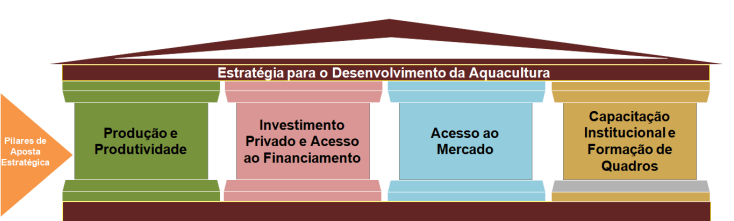
Pillars of the strategy for aquaculture development

The pillars of EDA’s strategy aim to solve the problems identified to ensure the sustainable development of aquaculture. These pillars include improving infrastructure and technology, strengthening institutional capacities, developing the market and promoting research and innovation.
Estratégia

Investment opportunities

The Mozambican government is committed to promoting commercial aquaculture, encouraging the participation of small-scale producers and attracting the private sector to invest in the activity. This scenario creates opportunities for investors interested in supporting and expanding aquaculture production in the country. The strategy for developing aquaculture in Mozambique aims to resolve the challenges identified and ensure sustainable growth. With the combination of small-scale aquaculture and the involvement of the business sector, a significant increase in fish production is expected, contributing to food and nutritional security, job creation and increased income for communities.

Financing aquaculture in Mozambique

Funding for the implementation of aquaculture development actions comes from the internal revenue budget, through tax and earmarked revenues. The government has defined aquaculture as a priority area, establishing a significant rate of earmarked revenue to boost its rapid development. The involvement of the private sector along the value chain is essential, and it is necessary to demonstrate the attractiveness of the business both domestically and for export. The support of cooperation partners is also crucial, mobilizing sufficient financial resources to implement the strategy.

Final notes

Aquaculture in Mozambique has enormous growth potential and offers significant investment opportunities. With the implementation of the Aquaculture Development Strategy, the country will be able to benefit from increased fish production, food and nutritional security, job creation, increased community income, tax revenues and foreign exchange.

Saiba quais os investimentos que o Banco BIG recomenda em 2024

O Banco BiG Moçambique divulgou recentemente a 1ª edição do estudo de mercado sobre Investimento Institucional em Moçambique – 2024. Com a realização  deste estudo, pretende-se proporcionar ao mercado moçambicano informação sobre as  perspectivas macroeconómicas e opiniões por parte dos principais intervenientes do  sector acerca do contexto actual e futuro de investimentos em Moçambique.

Foram inquiridos os serviços como, Sociedade Gestora de Fundos ou de Activos Financeiros, Fundo de Pensões, Sociedade Gestora de Fundos de Pensões e Seguradoras, nos quais, os respondentes foram CEOs, CFOs, e Gestores de Investimentos, respectivamente.

As conclusões sobre os diversos indicadores que constam deste estudo são apresentadas de uma forma agregada, no sentido de transmitir a opinião do sector no seu todo.

O estudo teve a participação de um perfil misto de participantes, dentre eles gestores de investimentos ou responsáveis por cargos similares de empresas de seguros,  sociedades gestoras de fundos de pensões, sociedades gestoras de fundos ou activos  financeiros, institutos de previdência social e outros.About WorO benchmark mais comum usado entre os gestores para avaliação dos retornos das suas carteiras de investimento é  a taxa dos bilhetes de tesouro (69% dos gestores).  Por outro lado, 15% dos inquiridos mencionaram não usar  nenhum benchmark.

Para a escolha de investimentos, os gestores consideram factores como a rentabilidade de investimentos, a  consistência dos rendimentos e o nível de risco, como os  factores mais relevantes.

Em contrapartida, a fiscalidade aplicável, a maturidade dos  investimentos assim como os custos associados,  mostraram-se ser de menor importância no momento da  escolha dos investimentos.

Verifica-se ainda que os critérios ESG estão a tornar-se um  critério relevante quando se trata da escolha de  investimento.

Para 2024, os inquiridos prevêem aumentar a sua exposição a BTs (69%), Papel Comercial (38%) e imobiliário (38%). Por outro lado, 77% dos inquiridos pretende diminuir a exposição a acções não cotadas, 62% a OT’s e 46% a acções cotadas e caixa e Depósito à Ordem.

Para 2024, a maioria dos inquiridos (77%) responderam que prevêem uma manutenção ou redução das taxas de rentabilidade de BTs e OTs em 2024.

85% dos gestores demonstraram optimismo em termos do crescimento do negócio em 2024. Em contrapartida, os restantes estimavam um abrandamento do negócio ou uma estagnação.

69% dos gestores prevê um aumento no número de empresas concorrentes no sector. Por sua vez, daqueles que prevê em o aumento, 67% são empresas de seguros.

Sumário das Conclusões

Para o ano 2024, 54% estima um crescimento do PIB entre 5% e 7,5%, ao passo que, quase metade dos gestores estima que as Reservas Internacionais Líquidas  (RIL) irão manter-se nos níveis actuais em 2024.

Num outro prisma, verifica-se que, acima de 80% dos inquiridos consideram a instabilidade política e o elevado endividamento público como os principais riscos para a economia, e cerca de 50% dos participantes prevê o levantamento da “força maior” da TotalEnergies no 2º semestre de 2024.

O estudo descreve igualmente, que 38% dos investidores estimam uma redução da taxa MIMO em 150bps no 3º trimestre de 2024. A taxa média de Bilhetes do Tesouro (BTs) é usada como benchmark na  avaliação da rentabilidade da sua carteira de investimentos por cerca de 69%  dos participantes.

A rentabilidade dos investimentos e a fiscalidade foram seleccionados como os factores mais relevante e menos relevante, respectivamente, na seleção de  investimentos. Para os próximos 12 meses, 69% dos inquiridos pretendem aumentar a sua exposição em BTs. Em contrapartida, 62% pretende reduzir a sua exposição  em OTs.

E por fim, 85% dos gestores consideram 2024 um ano em que o volume de negócio da sua actividade deverá registar um crescimento e 69% prevê um aumento do número de empresas concorrentes no seu respectivo sector.

Leia o estudo completo, em: Estudo de Mercado do Investimento Institucional

Financial Scenario: BIG Bank Reveals Investment Trends in Mozambique – 2024

Banco BiG Moçambique recently released the first edition of its market study on Institutional Investment in Mozambique – 2024. The aim of this study is to provide the Mozambican market with information on the macroeconomic outlook and the opinions of the main players in the sector on the current and future context of investments in Mozambique.

Services such as Fund or Financial Asset Management Companies, Pension Funds, Pension Fund Management Companies and Insurance Companies were surveyed, and the respondents were CEOs, CFOs and Investment Managers, respectively.

The conclusions on the various indicators included in this study are presented in aggregate form, in order to convey the opinion of the sector as a whole.

A mixed profile of participants took part in the study, including investment managers or those responsible for similar positions in insurance companies, pension fund management companies, fund or financial asset management companies, social security institutes and others.

The most common benchmark used by managers to assess the returns on their investment portfolios is the treasury bill rate (69% of managers). On the other hand, 15% of respondents mentioned not using any benchmark.

When choosing investments, managers consider factors such as the profitability of investments, the consistency of returns and the level of risk to be the most important factors.

On the other hand, the applicable taxation, the maturity of the investments and the associated costs proved to be of less importance when choosing investments.

It can also be seen that ESG criteria are becoming a relevant criterion when it comes to choosing investments.

For 2024, respondents plan to increase their exposure to BTs (69%), Commercial Paper (38%) and real estate (38%). On the other hand, 77% of respondents intend to decrease their exposure to unlisted shares, 62% to OT’s and 46% to listed shares and cash and Demand Deposits.

For 2024, the majority of respondents (77%) said that they expect the yields on BTs and OTs to remain the same or fall in 2024.

85% of managers were optimistic about business growth in 2024. On the other hand, the remainder expected business to slow down or stagnate.

69% of managers expect an increase in the number of competing companies in the sector. 67% of those who expect an increase are insurance companies.
Summary of Conclusions

For the year 2024, 54% estimate GDP growth of between 5% and 7.5%, while almost half of managers estimate that Net International Reserves (NIR) will remain at current levels in 2024.

On a different note, over 80% of those surveyed consider political instability and high public debt to be the main risks to the economy, and around 50% of the participants expect the “force majeure” of TotalEnergies to be lifted in the second half of 2024.

The study also shows that 38% of investors expect the MIMO rate to fall by 150bps in the 3rd quarter of 2024. The average rate of Treasury Bills (BTs) is used as a benchmark when assessing the profitability of their investment portfolio by around 69% of participants.

Return on investment and taxation were selected as the most relevant and least relevant factors, respectively, when selecting investments. For the next 12 months, 69% of respondents intend to increase their exposure to BTs. On the other hand, 62% intend to reduce their exposure to OTs.

Finally, 85% of managers consider 2024 to be a year in which the turnover of their business is expected to grow and 69% predict an increase in the number of competing companies in their respective sector.

Read the full study at: Estudo de Mercado do Investimento Institucional

Mozambique registers increase in visa-free tourists

Moçambique regista aumento de turistas com isenção de vistos

During the implementation of the visa facilitation and exemption decision in May, almost 30,000 travelers entered Mozambique. The government points out that a platform was created for online visa applications and exemption from tourist and business visas for a list of low-risk countries, as mentioned in the budget execution report for the fourth quarter of 2023.

The measure resulted in a total of 28,900 visas being issued, making Mozambique more competitive and facilitating access for potential investors. The government pointed out that the decision to facilitate and exempt tourist visas for low-risk countries had already increased the number of visits to the country by 34% in the first 90 days of implementing the measure, as announced in the third quarter of last year.

In December 2022, Mozambique introduced the Electronic Visa (e-Visa) and, on May 1, visa exemptions for citizens of 29 countries, as well as revising the measure to grant investment visas for longer periods to foreign citizens who hold investments in the country, simplifying the requirements for granting them.

The government estimates that the average daily “expenditure” of each visitor is 110 dollars, with an average visit time of four days, which represents 440 dollars “of new funds” for the economy. This measure aims to boost the tourism sector and attract more investors to the country.

Moçambique regista aumento de turistas com isenção de vistos

Moçambique regista aumento de turistas com isenção de vistos

No decorrer da implementação, em Maio, da decisão de facilitação e isenção de vistos, quase 30 mil viajantes entraram em Moçambique. O governo destaca que foi criada uma plataforma para pedidos de vistos online e isenção de vistos de turismo e negócios para uma lista de países de baixo risco, conforme mencionado no relatório de execução orçamental do quarto trimestre de 2023.

A medida resultou na emissão de um total de 28.900 vistos, tornando Moçambique mais competitivo e facilitando o acesso de potenciais investidores. O governo salientou que a decisão de facilitar e isentar vistos de turista para países de baixo risco já havia aumentado o número de visitas ao país em 34% nos primeiros 90 dias de implementação da medida, conforme anunciado no terceiro trimestre do ano passado.

Em Dezembro de 2022, Moçambique introduziu o Visto Electrónico (e-Visa) e, em 1º de Maio, isenções de visto para cidadãos de 29 países, além de rever a medida de concessão de vistos de investimento por períodos mais longos a cidadãos estrangeiros que detenham investimentos no país, simplificando os requisitos para sua concessão.

O governo estima que a “despesa” média diária de cada visitante seja de 110 dólares, com tempo médio de visita de quatro dias, o que representa 440 dólares “de novos fundos” para a economia. Essa medida visa impulsionar o sector do turismo e atrair mais investidores para o país.

Sector pesqueiro cresceu 9% em 2023

Sector pesqueiro cresceu 9% em 2023

A produção pesqueira de Moçambique teve um crescimento notável em 2023, atingindo 496,3 mil toneladas, representando um aumento de 9% em relação a 2022, quando foram registadas 455,5 mil toneladas.

Segundo o relatório de execução orçamental de Janeiro a Dezembro, divulgado pelo Ministério da Economia e Finanças, esse desempenho superou a meta estabelecida de 474,5 mil toneladas.

A pesca artesanal foi a modalidade que mais contribuiu, totalizando 466,4 mil toneladas, seguida da pesca comercial (industrial e semi-industrial), com 20,5 mil toneladas, e da aquacultura, com 9,5 mil toneladas.

No sector da pesca comercial, o destaque foi para o camarão, que liderou a produção com 1.341 toneladas, representando um aumento de 18,7% em relação ao ano anterior.

Já a aquacultura enfrentou desafios em 2023, como o excesso de chuvas que causou inundações em Maputo e a passagem do ciclone Freddy, que impactou especialmente as províncias de Inhambane e Zambézia. Esses fenómenos naturais resultaram na destruição de diversos equipamentos de pesca e aquacultura, afectando a produção.

A aquacultura em Moçambique é realizada ao nível industrial e em pequena escala, principalmente nas províncias de Tete, Gaza e Maputo, e produz uma variedade de peixes, camarão, caranguejo e lagosta.

Fishing sector grows 9% in 2023

Sector pesqueiro cresceu 9% em 2023

Mozambique’s fishing production grew remarkably in 2023, reaching 496.3 thousand tons, representing an increase of 9% compared to 2022, when 455.5 thousand tons were recorded.

According to the budget execution report for January to December, released by the Ministry of Economy and Finance, this performance exceeded the established target of 474.5 thousand tons.

Artisanal fishing contributed the most, totaling 466.4 thousand tons, followed by commercial fishing (industrial and semi-industrial), with 20.5 thousand tons, and aquaculture, with 9.5 thousand tons.

In the commercial fishing sector, the highlight was shrimp, which led production with 1,341 tons, representing an increase of 18.7% on the previous year.

Aquaculture, on the other hand, faced challenges in 2023, such as excessive rainfall that caused flooding in Maputo and the passage of Cyclone Freddy, which particularly impacted the provinces of Inhambane and Zambézia. These natural phenomena resulted in the destruction of various fishing and aquaculture equipment, affecting production.

Aquaculture in Mozambique is carried out on an industrial level and on a small scale, mainly in the provinces of Tete, Gaza and Maputo, and produces a variety of fish, shrimp, crab and lobster.

Moçambique vai receber novo pavilhão multiusos com apoio da Argélia

Moçambique vai receber novo pavilhão multiusos com apoio da Argélia

O Governo da Argélia comprometeu-se a disponibilizar cerca de 30 milhões de dólares para a construção de um pavilhão multiusos em Moçambique. O anúncio foi feito pelo Presidente Filipe Nyusi durante uma conferência de imprensa de balanço da sua visita de trabalho à Argélia.

Durante o encontro com o governante argelino, Abdelmadjid Tebboune, Nyusi expressou a necessidade de construção de uma arena multiusos no país, solicitando apoio financeiro, que foi prontamente aceite. O pavilhão multiusos será um espaço dedicado a diversas actividades desportivas e culturais, contribuindo assim para o desenvolvimento do desporto nacional.

Além do financiamento para a construção da infra-estrutura, a Argélia também manifestou disponibilidade para acolher estágios das equipas moçambicanas em diferentes modalidades desportivas.

O Presidente Nyusi iniciou a sua visita de trabalho de quatro dias à Argélia na Quarta-feira (28), a convite do Presidente Abdelmadjid Tebboune, participando também na 7.ª Cimeira de chefes de Estado e de Governo do Fórum dos Países Exportadores do Gás (FPEG/GECF).

Mozambique to receive new multipurpose pavilion with Algerian support

Moçambique vai receber novo pavilhão multiusos com apoio da Argélia

The Algerian government has pledged around 30 million dollars for the construction of a multipurpose pavilion in Mozambique. The announcement was made by President Filipe Nyusi during a press conference to take stock of his working visit to Algeria.

During the meeting with the Algerian ruler, Abdelmadjid Tebboune, Nyusi expressed the need to build a multipurpose arena in the country, requesting financial support, which was promptly accepted. The multipurpose pavilion will be a space dedicated to various sporting and cultural activities, thus contributing to the development of national sport.

As well as funding the construction of the infrastructure, Algeria has also expressed its willingness to host training camps for Mozambican teams in different sports.

President Nyusi began his four-day working visit to Algeria on Wednesday (28), at the invitation of President Abdelmadjid Tebboune, and also took part in the 7th Summit of Heads of State and Government of the Gas Exporting Countries Forum (FPEG/GECF).

Hidroeléctrica de Cahora Bassa destaca-se como maior contribuinte Estatal em 2023

A Hidroeléctrica de Cahora Bassa (HCB) destacou-se em 2023 como a empresa que mais dividendos pagou ao Estado moçambicano, a empresa, responsável pela exploração da barragem de Cahora Bassa, no rio Zambeze, na província de Tete, a HCB contribuiu significativamente para os cofres públicos com um montante de 4,6 mil milhões de meticais. Esse valor representa metade de todos os pagamentos feitos pelo Sector Empresarial do Estado (SEE) no período em análise.

O relatório de balanço do Plano Económico e Social e Orçamento do Estado (PESOE) também destacou outras empresas como grandes contribuintes, incluindo os Portos e Caminhos-de-Ferro de Moçambique (CFM), com 1,3 mil milhões de meticais, a Companhia do Pipeline Moçambique-Zimbabué (CPMZ), com 1,2 mil milhões, e a Empresa Nacional de Hidrocarbonetos (ENH), com 577 milhões de meticais.

Além dos dividendos, a HCB também se destacou nas receitas de concessão, contribuindo com 2,3 mil milhões de meticais, um aumento de 37% em relação a 2022. Esse pagamento representou 44% da receita total de concessões, demonstrando a robustez financeira e a contribuição significativa da HCB para o desenvolvimento económico de Moçambique.

Este facto reforça o papel crucial que a HCB desempenha na economia moçambicana e destaca a importância de empresas estatais sólidas e bem geridas para o progresso do país.